
This article was updated in September 2026. Previous version here.
The most basic form of transparency is just knowing whether an AI system is being used at all. There’s no chance to contest or audit an AI system’s decisions or impacts without that fundamental awareness. All of the more complex transparency information that might diagnose an AI system’s failures is downstream of that initial trigger. And so AI accountability hinges on building awareness in society and amongst the relevant forums about where AI is actually deployed within complex systems.
AI registers are one approach that might help build that necessary awareness by making publicly available an inventory of AI systems with societal impact. Since the earliest public registers were launched in Amsterdam and Helsinki in 2020 (Floridi, 2020), there’s been a proliferation of them around the world, with one recent report clocking 83 (Gutiérrez and Muñoz-Cadena, 2024). New York City has one, as does San Jose. An executive order in the US in late 2020 called for federal agencies to publish public inventories of AI use which was later codified into law (which sunsets in 2027) and elaborated by the executive branch, while in the EU the AI Act calls for a register of high-risk AI systems. A number of states have also enacted laws which legislate AI registers to varying degrees (Anex-Ries, 2024).
Nieuwenhuizen’s interview study of oversight authorities and societal watchdogs in the Netherlands found that “one of the most significant positive implications is that the register serves as a crucial starting point for further investigations. The information, or its absence, acts as a point of departure for in-depth examinations.” (2024). By making some basic information public, AI registers provide a foothold for further scrutiny. Research on the Canadian federal public AI register has further demonstrated the downstream analytic value of having a national AI register, namely to provide an overview of the various ways AI is used across government, to track the framing of those uses, and to understand gaps or “bureaucratic silences” (Das et al, 2026).
AI registers have been critiqued over the quality of information included in them, echoing previous observations about AI transparency in general. Issues brought up include accuracy, inconsistency, and understandability of metadata as well as the relevance and comprehensiveness of what systems are selected for inclusion (Meijen and Gujela, 2025; Cath and Jansen, 2022). In the absence of a legal mandate which dictates these elements, authorities can selectively include or exclude AI systems or information about them or inconsistently provide that information (Das et al, 2026; Nieuwenhuizen, 2024). Discretion in the disclosure process is seen as problematic for realizing the full value of registers (Popa, 2025; Pi et al, 2026). As Das notes in their critique of the Canadian AI register, “even when systems are disclosed, they often omit governance-critical information, including degrees of uncertainty, training arrangements, and discretion configuration, while departmental latitude to reinterpret central directives produces heterogeneous reporting standards” (Das et al, 2026). Cath and Jansen further critique AI registers on the grounds that they normalize the use of AI in public bodies (2022), though given the proliferation of AI throughout society it seems society is well beyond debating whether to use AI, and is now more concerned with using it responsibly.
Nieuwenhuizen elaborates several design considerations for effective AI registers, including specifying the audience for the information, the unit of disclosure, disclosure formats, and what details to include (2024). Structural best practices outlined by the Center for Democracy and Technology include collating registries across the government, standardizing information reported across agencies, making registries fully public, updating registries on a set periodic schedule, ensuring inventory language is accessible and understandable (and also machine readable), and making sure there is accountable leadership for the registry process (Anex-Reis, 2024). These ideas help push toward addressing at least some of the information quality issues outlined above.
There is also the question of what exactly to include in an AI register. An analysis of 16 different inventories from around the world identified a harmonized set of 23 distinct fields with a descriptive core set included in most inventories (Das and Guha, 2026). This core included name, responsible organization, description, technology type, and lifecycle status, while fewer registers included information about risks and legal bases, external evaluations, or appeal processes (See Figure). Some standards have begun to emerge which outline what exactly should go in an AI register. In the UK, the Algorithmic Transparency Recording Standard (ATRS) “establishes a standardised way for public sector organisations to publish information about how and why they are using algorithmic tools”. And a consortium of European cities has developed an Algorithmic Transparency Standard, which is meant to help cities “provide clear information about the algorithmic tools they use, and why they’re using them.” These standards articulate tiers of information and define and help standardize what to include.
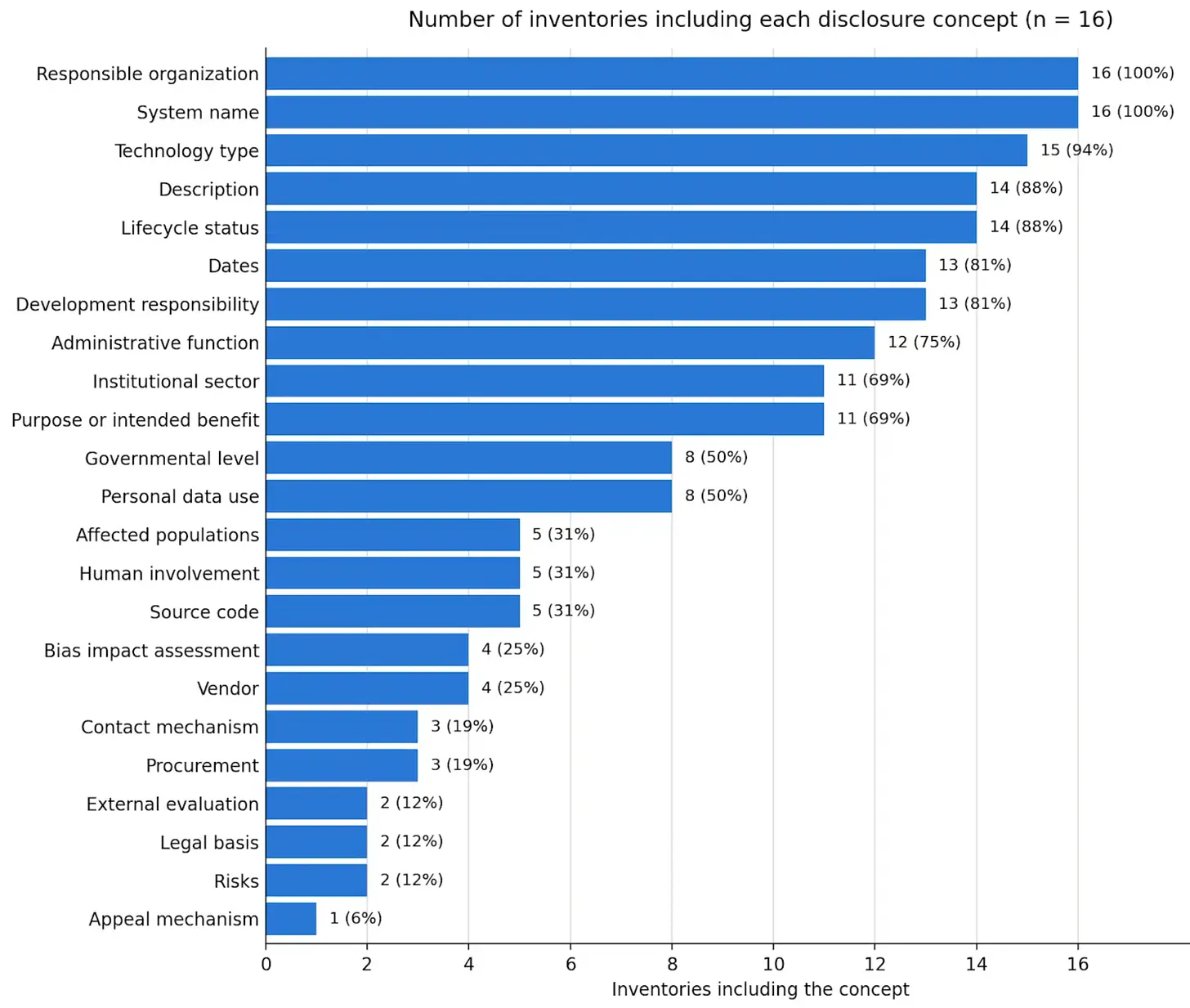
The development of standards is critical for specifying which bits of data belong in a register, but those standards also need a governance layer to enforce them and to verify information quality. As Das and Guhu show, just because there is a robust scheme for information disclosure doesn’t mean it will always (or even often) be mostly filled out (2026). One approach recently developed is to establish a checklist to audit whether a register fulfills expectations set out in the standard (Peljto et al, 2026). Ideally policy would require such an audit against established standard criteria for a register. Auditing needs to be done by an entity with enough access to the process to accurately evaluate whether certain criteria were met.
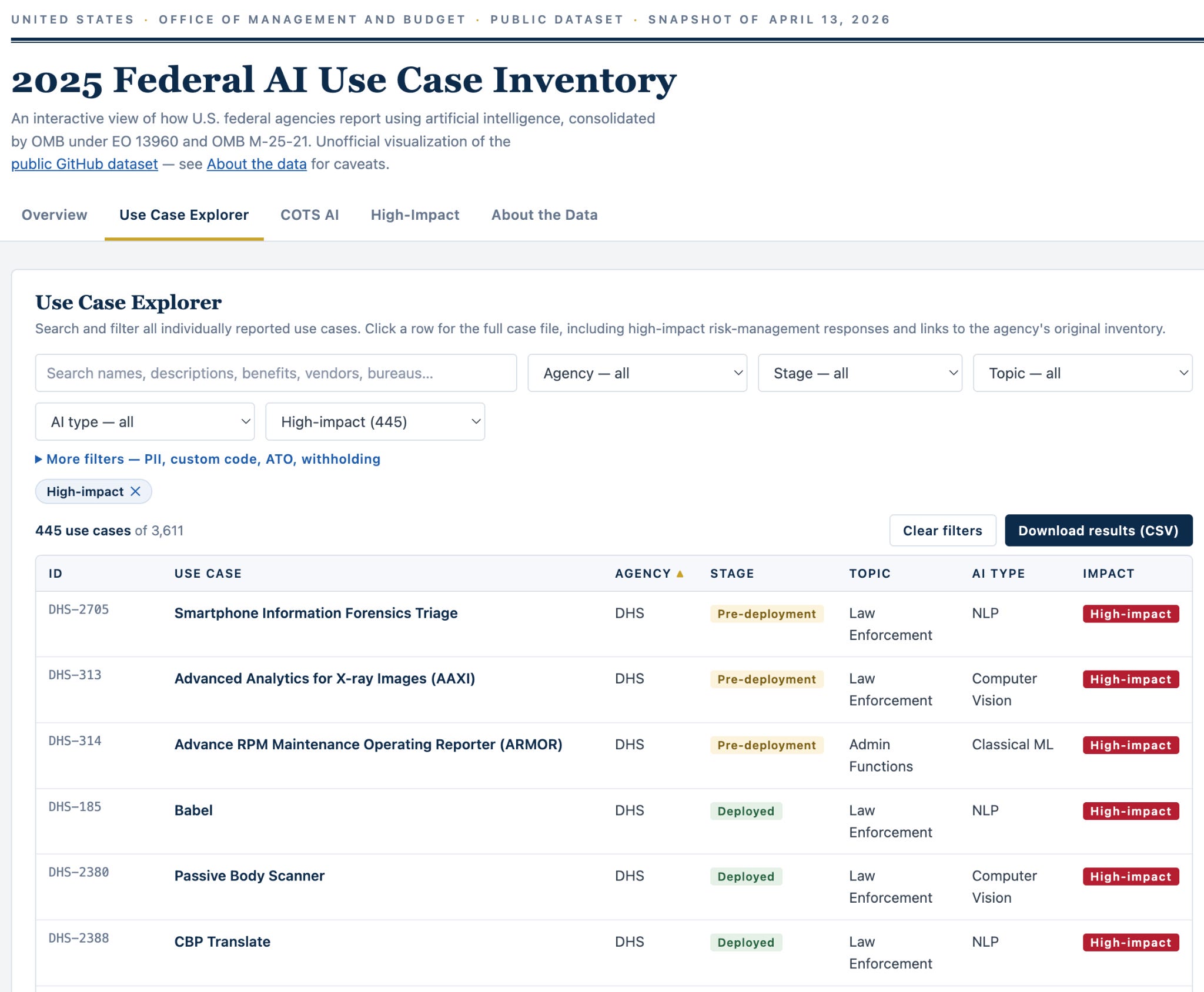
The US federal example is surprisingly responsive to the issues of information quality raised in the above critiques, with the Office for Management and Budget (OMB) guidance helping to set the scope for inclusion, articulate exclusions or consolidate common cases (like using generative AI to summarize a document), encourage understandability of text, designate high risk cases, and even normalize metadata that was reported differently by different agencies. Still, it remains unclear what the protocol should be to rigorously assess the accuracy, comprehensiveness, bias and other aspects of information quality provided in the register. Perhaps OMB should audit those things as part of an administrative chain using a checklist akin to what (Peljto et al, 2026) proposes, but perhaps that is also where the work of accountability begins for external forums that might solicit more information on any of the cases disclosed using a freedom of information request. And, while it’s a great first step to make the data available, it’s still not terribly accessible in terms of ease of searching, filtering, or visualizing what’s there. Though forums can now leverage AI to build interactive analytic dashboards to support this last step. It only took me about fifteen minutes to create one for the 3611 federal use cases for AI reported in 2025.
References
Anex-Ries Q (2024) Best Practices for Public Sector AI Use Case Inventories. Center for Democracy and Technology.
Cath C and Jansen F (2022) Dutch Comfort: The Limits of AI Governance through Municipal Registers. Techné: Research in Philosophy and Technology 26(3): 395–412.
Das D, Tessono C, Ahmed SI, et al. (2026) Bureaucratic Silences: What the Canadian AI Register Reveals, Omits, and Obscures. Proceedings of the 2026 ACM Conference on Fairness, Accountability, and Transparency: 4003–4026.
Das D and Guha S (2026) A Global Comparison of Schemas, Transparency, and Interoperability in Public-Sector AI Registers and Inventories. ACM Conference on Digital Transformation.
Floridi L (2020) Artificial Intelligence as a Public Service: Learning from Amsterdam and Helsinki. Philosophy & Technology 33(4): 541–546.
Gutiérrez JD and Sarah Muñoz-Cadena (2024) Algorithmic Transparency in the Public Sector: A state-of-the-art report of algorithmic transparency instruments. Global Partnership on AI (GPAI).
Meijen J and Gujela N (2025) Empowering Citizens through Responsible AI Governance: Policy Recommendations for Public Algorithm Registers. Advancing Responsible AI in Public Sector Application, GPAI Edition. 51–61.
Nieuwenhuizen E (2024) Algorithm Registers: A Box-Ticking Exercise or Meaningful Tool for Transparency? Information Polity 29(4): 415–433.
Peljto I, Heilmann X and Cerrato M (2026) Are Algorithm Registers Transparent? Perspectives from Germany. arXiv. Epub ahead of print 2026. DOI: 10.48550/arxiv.2606.02347.
Pi Y, Singh J and Li W (2026) Understanding the Role of Algorithm Registers in AI Governance Through Comparative Analysis of China and the UK. Proceedings of the 2026 ACM Conference on Fairness, Accountability, and Transparency: 3367–3391.
Popa DM (2025) Frontrunner model for responsible AI governance in the public sector: the Dutch perspective. AI and Ethics 5(3): 2789–2799.
I love this!