
It’s not hard to see that GenAI creates epistemic risk in the information ecosystem. Not only can models output hallucinations and misinformation that misleads people, but they can also misattribute ideas to the wrong source (or no source at all), making it more difficult for people to verify where an idea or fact came from. So, how about we slap an “AI” label on content output from generative AI models. Would this kind of AI labeling help address these issues for information consumers?
In a recent paper published in Digital Journalism we report on an interview study where we talked to news audiences in the US about some of the problems AI labeling might address for them. Participants described how labels can enhance their understanding of responsibility, clarify attribution, cue credibility, maintain trust, and enhance their autonomy. But it wasn’t just an “AI” label that they desired. They also wanted more clarity on how people were involved in the content creation process, such as oversight or specific tasks they were assisted with. The signalling of human oversight was seen as a way to re-assure audiences about information integrity. Labeling AI output was seen as a way to support reader autonomy so they could effectively opt in or out of consuming a piece of content depending on their context.
Audiences see some potential benefit from AI labeling, and apparently policymakers do too. It’s the main idea behind recently passed (but not yet signed by the governor) legislation in the state of New York called the “fundamental artificial intelligence requirements in (FAIR) news act”. That proposal calls for news media published or disseminated in New York to “conspicuously imprint” at the top of the page that the content was “substantially created by generative artificial intelligence.”
The recently published EU Code of Practice on AI-Generated Content also specifies how to fulfill the EU AI Act’s requirement for labeling by deployers (i.e. users) of AI used for creating content. Whereas the NY law doesn’t specify what labels should look like in practice, the EU code offers a set of reference icons that deployers can use for labeling fully AI generated or AI modified content:
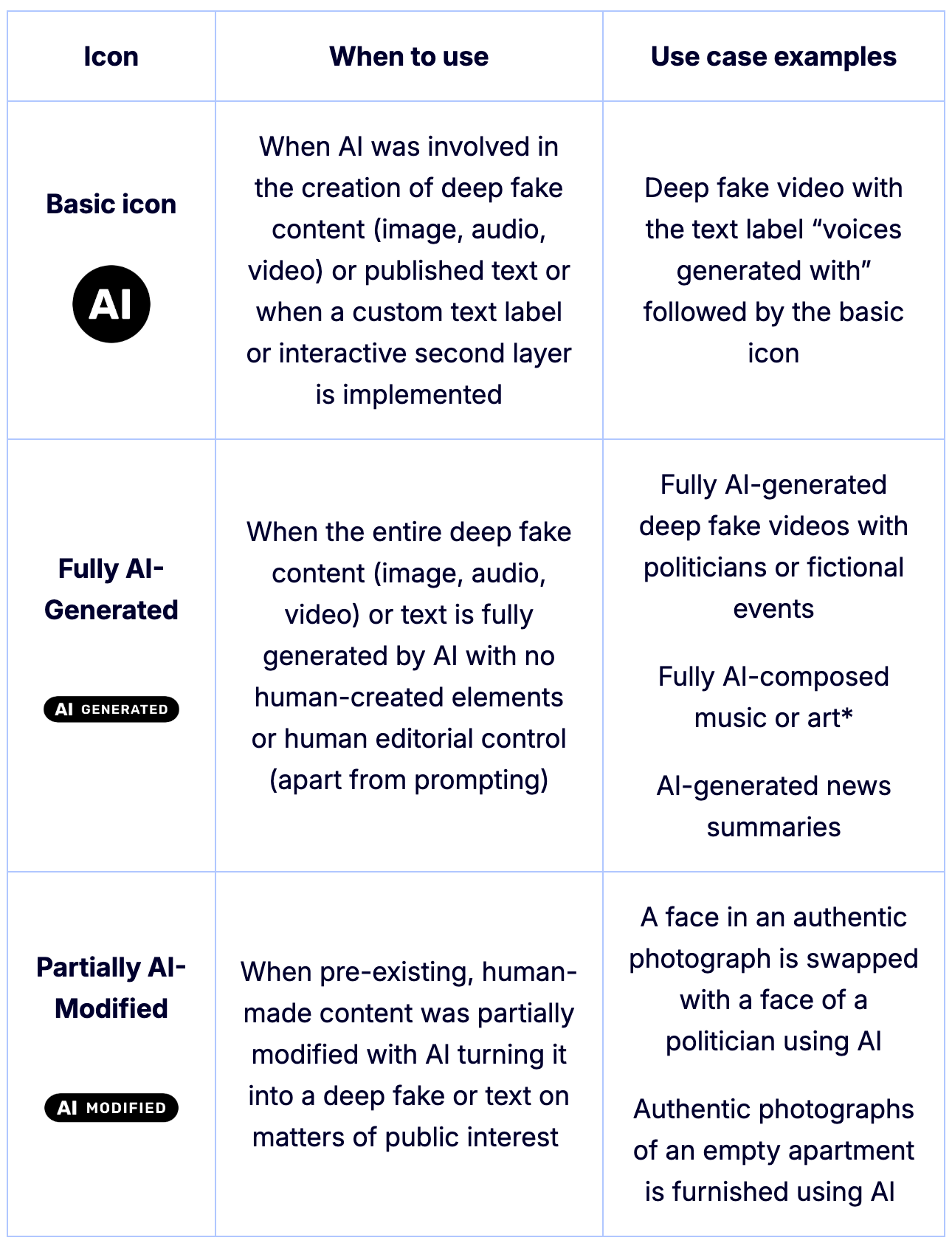
While the core idea is similar, the scope of the two laws is different and reflects differing value trade-offs. The NY law is scoped around news media which is broadly defined to include “news, weather, traffic, sports, or entertainment” published across a range of formats, whereas the EU law applies to all AI-generated images, audio, and video as well as text “with the purpose of informing the public on matters of public interest.” The EU law has an exception for content with human oversight, where the obligation to label doesn’t apply when “the AI-generated content has undergone a process of human review or editorial control and where a natural or legal person holds editorial responsibility for the publication of the content.” Whereas New York is explicitly targeting news media, the EU has what is essentially a carve out for news media as long as they ensure there’s editorial oversight and a person who takes responsibility and is publicly identified. That exception trades-off reader autonomy in choosing to opt out of AI-generated content in exchange for naming an explicit entity being responsible/accountable for the content. In that sense the New York law is a stronger statement for empowering the reader with the knowledge that something was produced by AI, regardless of any editorial oversight. The EU rule seems to be a slippery slope: Who defines the level or degree of editorial oversight that warrants this exception?
Another point to consider is that neither policy proposal is particularly clear on what is probably the most typical case: AI-assisted content creation. Especially given the audience demand for understanding human-AI co-involvement in creation that we saw in our study, how can we label content when both AI and people play different roles? This is a real struggle highlighted by a recent case where a McClatchy newsroom unionized in order for reporters to assert that they didn’t want to be named in a byline used to label content that had been automatically generated based on their original reporting and writing. Whereas the company thought that by naming the reporter this would provide the responsibility and accountability for the content, the reporters themselves felt that their loss of autonomy in the deployment and use of the technology undermined any sense of responsibility they felt for the AI-generated output. In this case, the reporters felt that a byline indicating “AI assistance” was unwarranted given the role they played in producing the output.
I don’t blame policymakers for not wanting to wade into the sticky territory of determining how to label jointly-produced content. It’s easier to stick to a clear “AI” (or not) label. If AI was used to produce the content, then label it, and let end-users opt out accordingly. If there was enough human effort to not have to label it “AI”, either because there is editorial oversight in the EU, or because it meets the standard for copyrightability in New York, then maybe it doesn’t need that AI label at all. In that case it’s perhaps better to have a human byline to make responsibility for the content clear. But that person also has to be willing to assume that responsibility and not have a corporation foist it on them.
The exception for news media in the EU strikes me as interesting. I think it will be quite tough to verify adherence to this without a firmer idea of what qualifies as proper "editorial review" or oversight. Thanks for laying this out so clearly.
This was an insightful piece, Nick. As a strong advocate for transparency, I generally support AI labeling and giving consumers the information they need to decide what they engage with.
I also suspect we’ll see a growing premium placed on distinctly human-created work. Just as handcrafted products command higher value today, content created with minimal AI assistance may eventually become a differentiator in its own right.
It will be fascinating to watch how policy evolves—particularly around the New York Act and whether regulation ultimately aligns with what consumers actually want: transparency, accountability, or some combination of both.