
Accountability hinges on being able to identify the responsible actors in an AI system. But attributing responsibility in a complex AI system can be a complicated enterprise demanding many different forms of information.
Like accountability, responsibility is a relational concept: people are responsible to someone for something, creating “an expectation of an action or its result” (Lenk, 2006). Depending on the who and what in that relationship can lead to different flavors of responsibility, like moral responsibility, or legal responsibility. Vincent (2011) counts at least six different concepts referred to by the word “responsibility”, including virtue responsibility (i.e. character and commitment to doing what’s right), role responsibility (i.e. the duties an actor should or shouldn’t do), outcome responsibility (i.e. backward looking attribution for a state of affairs), causal responsibility (i.e. the cause of the state of affairs), capacity responsibility (i.e. whether the actor has the requisite cognitive or material ability to be responsible), and liability responsibility (i.e. the financial or other action needed to make things right).
Building on decades of research on the psychology and cognition of how humans assign responsibility (e.g. Attribution Theory — Kelley and Michela, 1980), Franklin and colleagues (2022) published a model of AI responsibility that implicates nine different factors and their relationships in attributing responsibility:
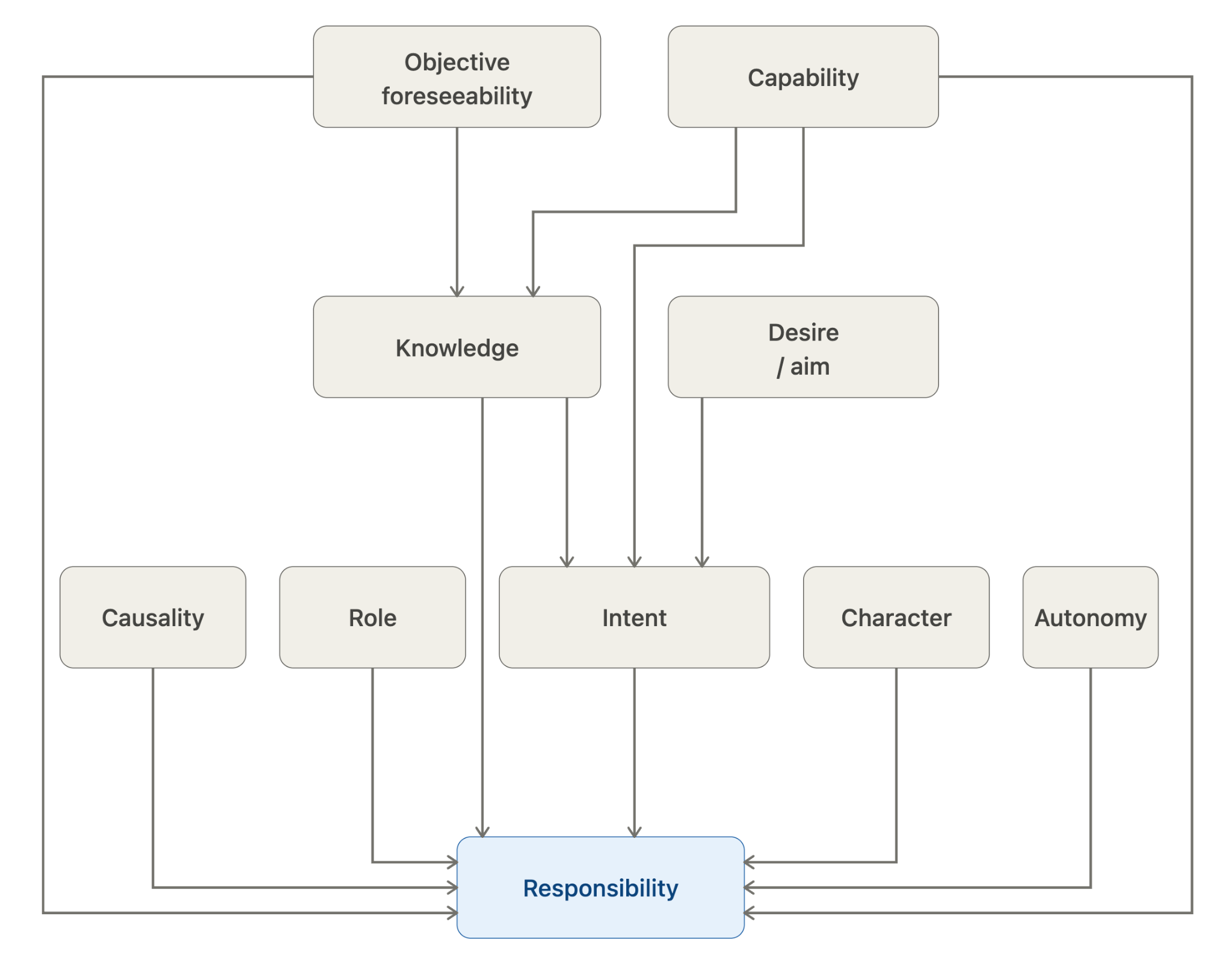
There are overlaps and analogues to some of the philosophical conceptions of responsibility Vincent outlines, including causality, role, character (i.e. virtue), and capability. Additional factors include intent—classically associated with assignments of moral responsibility (Nissenbaum, 1994), desire/aim (i.e. an orientation that precedes commitment to an intended action), objective foreseeability (i.e. how likely an outcome really is, regardless of the agent’s expectations), and autonomy (i.e. ability for agent to freely make decisions). Failure to clarify these factors can lead to what has been termed a “responsibility gap”, such as when a person lacks sufficient knowledge over an autonomous AI system whose interactions with the environment make its behavior difficult to foresee (Matthias, 2004).
Some of these factors can be elaborated or nuanced further. As one example, the causality factor can be broken down into an internal (i.e. factors about the automation itself like its programming) vs. external (i.e. situational factors or data quality) cause, which also shapes how people perceive responsibility (Pareek et al, 2025). Another dimension that is relevant to how people view responsibility is whether the situation is low or high-stakes (Tsumura and Yamada, 2025; Pareek et al, 2025). Moreover, a cross-cultural study showed that while intent is implicated in moral judgements in many large-scale industrialized societies, there are some small-scale societies where it is not (Barrett et al, 2016), which has implications for global AI responsibility standards and policy.
These various factors are helpful for analyzing responsibility in an AI system. For instance, an autonomous vehicle (AV) may have physically caused the damage to another car that it rear-ends during a snow storm. But if the driver was supposed to be vigilant (i.e. that was their role responsibility) we might think they share some of the outcome responsibility. If the driver was distracted by a TV show they were watching on their phone, this might weigh the responsibility more toward them (i.e. due to a character failure). In contrast, if the deploying company had knowledge that the AV lacked the capability to detect and stop before hitting another vehicle in a common situation like a snow storm, they could have objectively foreseen such an incident, weighing the responsibility toward them.
What does this all mean practically for AI accountability? These factors enumerated above should play a more explicit role in what we expect from AI system explanations. In order to make nuanced decisions about assigning responsibility and calling for accountability, explanations of AI systems need to include information that helps accountability forums assess things like capability, knowledge, causality, character, role, intent, and autonomy of actors in the system. These factors suggest bits of information needed to inform responsibility judgements and should be the basis for explanation requirements and transparency regimes so that the needed information is available. Accountability forums such as the media or administrative agencies can use the factors to inform lines of questioning, AI incident cards could be designed to include descriptions of each factor, and a growing list of AI regulations around the world could be analyzed through this framework to assess whether they’re really compelling the right information needed for responsibility assignment.
References
Barrett HC, Bolyanatz A, Crittenden AN, et al. (2016) Small-scale societies exhibit fundamental variation in the role of intentions in moral judgment. Proceedings of the National Academy of Sciences 113(17): 4688–4693.
Franklin M, Ashton H, Awad E, et al. (2022) Causal Framework of Artificial Autonomous Agent Responsibility. Proceedings of the 2022 AAAI/ACM Conference on AI, Ethics, and Society: 276–284.
Kelley HH and Michela JL (1980) Attribution theory and research. Annual review of psychology 31(1): 457–501.
Lenk H (2006) What is Responsibility? Philosophy Now (56). https://philosophynow.org/issues/56/What_is_Responsibility
Matthias A (2004) The responsibility gap: Ascribing responsibility for the actions of learning automata. Ethics and Information Technology 6(3): 175–183.
Nissenbaum H (1994) Computing and accountability. Communications of the ACM 37(1): 72–80.
Pareek S, Schömbs S, Velloso E, et al. (2025) “It’s Not the AI’s Fault Because It Relies Purely on Data”: How Causal Attributions of AI Decisions Shape Trust in AI Systems. Proceedings of the 2025 CHI Conference on Human Factors in Computing Systems: 1–18.
Tsumura T and Yamada S (2025) Effects of knowledge and importance on responsibility in human-AI decision making. Scientific Reports 16(1): 2670.
Vincent NA (2011) A Structured Taxonomy of Responsibility Concepts. In: Moral Responsibility. Library of Ethics and AppliedPhilosophy, pp. 15–35.