
When an AI system outputs a harmful, incorrect, or perhaps just disagreeable decision, we often want to challenge it through a process of contestation. The contestation process reflects the communication exchange or dialog between stakeholders that is core to the definition of accountability. A successful challenge could lead to an overturned decision, a redesigned or abandoned system, structural changes to system governance, or compensation for impacted stakeholders.
Contestation is an argument between a stakeholder and the AI system. Illustrated in the next figure, the steps of an idealized version of the process go something like this: (1) Harm Discovery: The AI system outputs a harmful decision and a stakeholder learns of it, (2) System Explanation: The stakeholder may request an explanation of the decision provided by the AI system to provide additional understanding for why the system produced the output, (3) Challenge Consideration: The stakeholder considers whether a challenge is warranted based on the system-provided explanation as well as any other available information (e.g. transparency, documentation, audits, etc), (4) Challenge Argument: The stakeholder disagrees with the decision and presents an argument for changing it, grounded in their own information and interpretation, (5) AI System Argument: The AI system may provide a justification to further ground the system output in normative reasons and argue against the stakeholder’s challenge, (6) Resolution: Adjudication of the argument for either the system (the decision stands) or the stakeholder (some change is warranted in the decision or system).
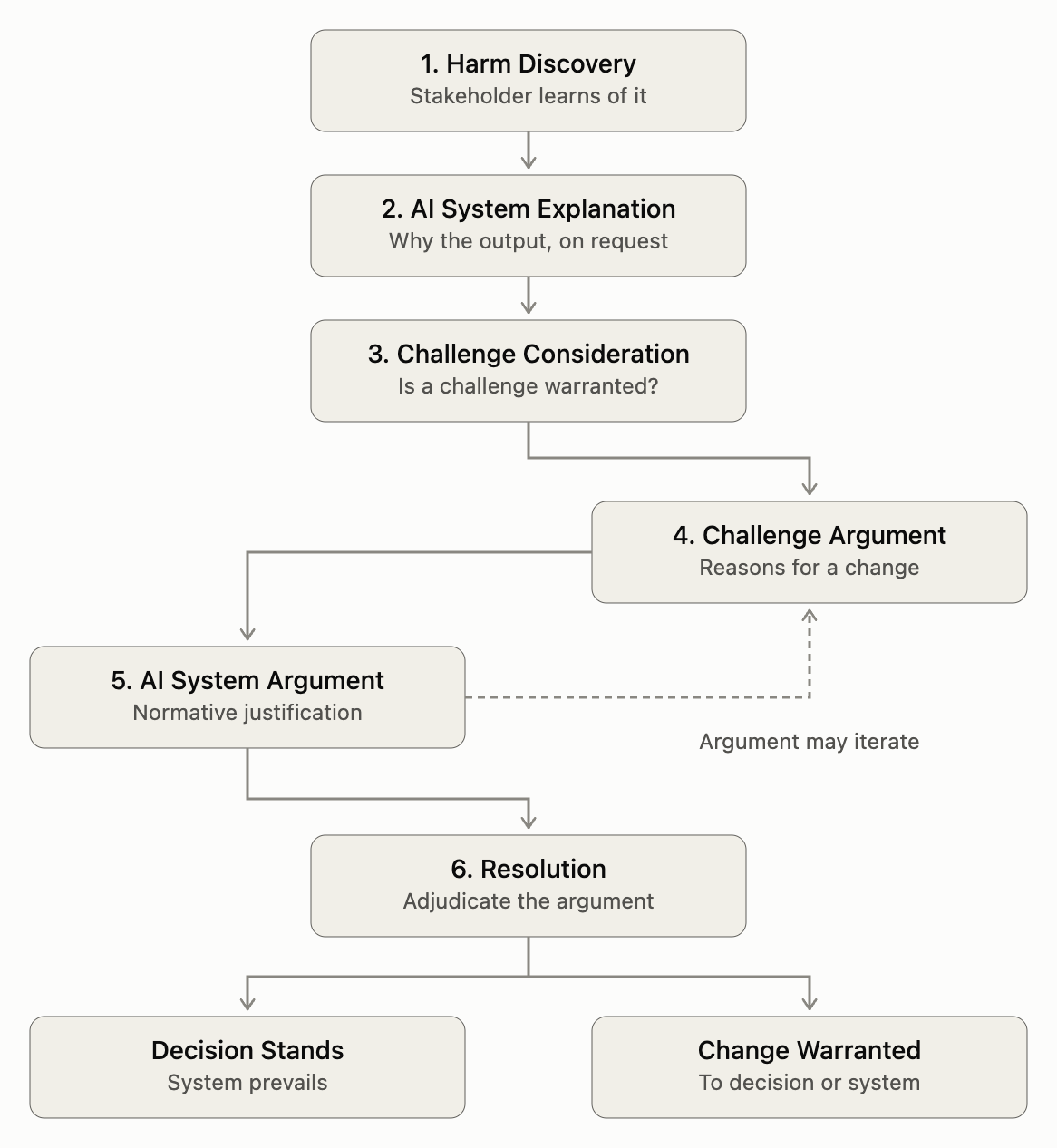
In reality this isn’t a neat or tight process, as research examining dozens of real AI contestation cases has shown, it is an “interactive, dynamic, and often prolonged process” (Pi et al, 2026). It can also vary if the object of contestation is instead the system design itself, or institutional practices that govern the system. The power to compel explanations and justifications and ultimately adjudicate arguments towards resolution is something that legal, political, media or other forums provide in different ways. Power is the key here. In the idealized process the contester is deemed to have the power or authority to expect an explanation or justification. But in reality, operators might not be so cooperative and instead deny or deflect responsibility for the outcome, downplay the severity of the impact, restrict communication channels that enable contestation, blame human operators, withhold information, or strategically concede or delay the process (Pi et al, 2026).
Contestation is supported by available information about the system, as provided through various transparency mechanisms (e.g. auditing, documentation, etc.). It hinges on both explanation and justification. Explanation is about helping someone understand a decision and the facts underlying it, whereas justification is about offering the reasons for why the output is appropriate or acceptable (Henin and Le Métayer, 2022). Explanations offer descriptions of the process leading to the output, whereas justifications draw on norms like law, corporate policy, or ethical principles to argue that the norm supports the outcome provided. The back and forth of explanation and justification needs to be supported by some communication channel that facilitates clear dialog such as a natural language or interactive interface (Yurrita et al, 2025).
To see the distinction between explanation and justification and how they relate to contestation, consider an AI system used by a bank to deny a loan application. The explanation might be that the loan was declined because the applicant’s debt-to-income ratio is above some threshold, whereas the justification is that when debt-to-income is above that threshold it violates the bank’s responsible lending policy and protects the applicant from unaffordable debt. Contestation comes in when arguing against either the explanation (on epistemic grounds) or justification (on normative grounds): perhaps the bank’s data on the applicant’s debt-to-income is inaccurate, or perhaps there is a fair lending norm that could be argued to override bank policy that only narrowly considers that threshold.
Contestation is often framed as something an individual does retrospectively perhaps as an individual right one has as an end-user impacted by the system (Kaminski and Urban, 2021) — an idea reflected in Article 22 of the EU’s GDPR regulation. However, there are also different types of individual stakeholders, from operators to auditors that might also contest a system or its output (Henin and Le Métayer, 2022). Beyond individual contestation there is also interest in enabling groups or coalitions to collectively contest an outcome (Lyons et al, 2021; Schmude et al, 2026; Yurrita et al, 2025). Contestation can be an expensive activity and coalitions or groups (e.g. public-interest, professional, or union organizations) can often marshal more resources, information, and sensemaking capacity while sustaining pressure for change over time (Yurrita et al, 2025). As Upadhyay et al write, “successful contestation can be deeply relational, relying on situated knowledge and coalitions to determine which information is most compelling for a given contestation strategy, how to obtain it, and what actions can achieve accountability while mitigating risks.” (2026). A simple way to put this is that groups of people are more powerful than individuals, so there’s an incentive to work together to better address the power differential with many AI systems.
Contestation through Design
Contestation need not be something invoked only retrospectively. Research has considered how contestation can be supported in the design of a system (Hirsch et al, 2017). Various system design features may enable contestation, such as including a human review process where operators can adjudicate challenges, enabling individuals to find others similarly impacted so they can create coalitions, providing adequate transparency such as appropriate documentation, and incorporating participatory design to better address aspects of the system that might be contested upfront (Alfrink et al, 2022). The general idea is to make AI systems “open and responsive to human intervention throughout their lifecycle: not only after an automated decision has been made, but also during its design and development” (Alfrink et al, 2022).
Veluwenkamp and Buijsman articulate two design features needed to enable operator contestation: epistemic access to the relevant normative reasons (i.e. justifications) for outputs, and authority to act on these reasons (2025). Basically if the operator is going to act as adjudicator of a contestation they need access to system justifications and the authority to consider and potentially override them based on a challenger’s counter argument. Some of the valid reasons they consider for why a system explanation or justification might be challenged include (1) inaccurate system data, (2) data drift such that the model no longer fits reality well, (3) missing data features, (4) system bias, and (5) spurious correlation. The epistemic and normative grounds for contestation based on inaccurate system data and missing data features have recently been formalized (Freiesleben et al, 2026). A further opportunity for epistemic contestation is when there is predictive multiplicity — when different models derived from the same model building process produce different outputs (Freiesleben et al, 2026).
Can AI Argue Back?
Some research considers the possibility that AI systems are able to engage in the contestation process automatically. This requires a system not only to be able to render explanations which are faithful, but also justifications, to interactively argue with a person (or other AI) about an output via a communication channel like natural language, and ultimately to potentially update itself if the contest is deemed valid (Leofante et al, 2024). Fully automating these processes is not currently plausible given that systems often lack access to the reason giving capacity needed for justification (Jahromi et al, 2026).
Henin and Le Métayer are perhaps furthest along in prototyping the possibility here with their Algocate system (2021). The system has access to evidence and norms to logically back an output decision and is equipped with a capacity to compare and rank arguments based on strength. Still, to successfully navigate a resolution, such a system would need to be provided with the authority to overturn a decision, something which adversarial operators with something to lose are unlikely to want to do. People also don’t want to argue with AI systems towards resolution, preferring to have a human reviewer with the requisite capacity to evaluate the challenge and the authority to override the system if needed (Yurrita et al, 2025) though there is also sensitivity to the higher costs this might entail (Lyons et al, 2025).
What Policy Can Do
A primary role of policy to support contestation should be to set the ground rules for fair contestation arguments to take place, with the ultimate goal of enabling better AI system decisions. This means deciding who can contest (e.g. individuals, collectives, etc) and what can be contested (not just outputs but also systemic issues), making sure both sides of the argument have access to relevant information, explanations, and justifications (e.g. through system design features), ensuring communication and interaction channels are available for enabling the argument, and authorizing some entity with the appropriate authority for adjudication. In addition, policy can support harm discovery through more thorough transparency rules and enabling forums such as the media or civil society that engage in monitoring activities.
Ultimately a contestation reflects a power struggle between two entities and policy needs to work to equalize power differentials. To counteract powerful AI system operators, policy might insist on timely disclosure of relevant information, persistent channels for raising challenges, and protection of contesters against retaliation. AI systems should not be authorized to adjudicate challenges not only because the technology to support such computational argumentation is still nascent, but also because it reflects a conflict of interest that undermines fairness. Finally, since coalitions can marshal more resources, information, and sustained pressure than individuals can, policy should enable collective contestation. Policy can create infrastructure that helps affected individuals find and learn from each other such as by establishing public registers of deployed systems and contestation outcomes.
References
Alfrink K, Keller I, Kortuem G, et al. (2022) Contestable AI by Design: Towards a Framework. Minds and Machines 33(4): 613–639.
Freiesleben T, Meding K and König G (2026) Explainable AI Isn’t Enough! Rethinking Algorithmic Contestability. Proceedings of the AAAI/ACM Conference on AI, Ethics, and Society 9(2): 961–973.
Henin C and Métayer DL (2021) A framework to contest and justify algorithmic decisions. AI and Ethics 1(4): 463–476.
Henin C and Métayer DL (2022) Beyond explainability: justifiability and contestability of algorithmic decision systems. AI & SOCIETY 37(4): 1397–1410.
Hirsch T, Merced K, Narayanan S, et al. (2017) Designing Contestability: Interaction Design, Machine Learning, and Mental Health. DIS. Designing Interactive Systems (Conference) 2017: 95–99.
Jahromi MNS, Holm S, Moeslund TB, et al. (2026) Operationalizing AI contestability through technical feasibility analysis. Discover Artificial Intelligence 6(1): 648.
Kaminski M and Urban J (2021) The Right to Contest AI. Columbia Law Review. 121, 7: 1957–2048
Leofante F, Ayoobi H, Dejl A, et al. (2024) Contestable AI needs Computational Argumentation. Proceedings of the International Conference on Principles of Knowledge Representation and Reasoning.
Lyons, H., Velloso, E., & Miller, T. (2021). Conceptualising contestability: Perspectives on contesting algorithmic decisions. Proceedings of the ACM on Human-Computer Interaction, 5(CSCW1), 1–25
Lyons H, Miller T and Velloso E (2025) Diametrically Opposed Attributes? Review Process Preferences and Priorities When Contesting Algorithmic Decisions. Proceedings of the ACM on Human-Computer Interaction 9(7): 1–32.
Pi Y, Lichner L, Lee JW, et al. (2026) Push and Pushback in Contesting AI: Demands for and Resistance to Accountability. Proceedings of the 2026 ACM Conference on Fairness, Accountability, and Transparency: 3590–3625.
Schmude T, Yurrita M, Alfrink K, et al. (2026) Two Means to an End Goal: Connecting Explainability and Contestability in the Regulation of Public Sector AI. In: Conference on Fairness, Accountability, and Transparency, 2026, pp. 3078–3104.
Upadhyay S, Pruss D, DeVrio A, et al. (2026) “It just requires so much more creativity”: Barriers and Workarounds to Gathering Information for AI Contestation. Proceedings of the 2026 CHI Conference on Human Factors in Computing Systems: 1–18.
Veluwenkamp H and Buijsman S (2025) Design for operator contestability: control over autonomous systems by introducing defeaters. AI and Ethics 5(4): 3699–3711.
Yurrita M, Verma H, Balayn A, et al. (2025) Identifying Algorithmic Decision Subjects’ Needs for Meaningful Contestability. Proceedings of the ACM on Human-Computer Interaction 9(7): 1–29.